Best Garbage Disposals for Kitchen Waste
Affiliate Disclosure: HomeGear Guide is reader-supported. When you buy through links on our site, we may earn an affiliate commission at no extra cost to you. We do not accept paid product placements or sponsor-biased reviews.
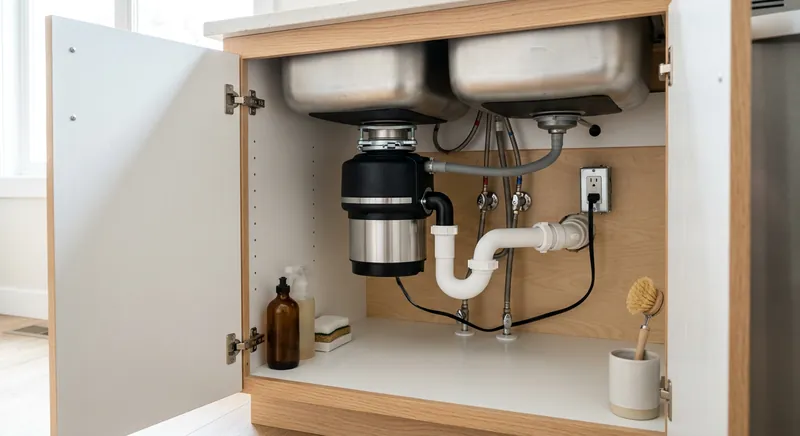
A garbage disposal grinds food waste so it can flow through your plumbing instead of ending up in the trash. Not all disposals are equal, and choosing the wrong one leads to clogs, noise complaints, or a unit that jams every time you put celery down the drain. Horsepower, grind stages, and feed type are the three factors that determine how well a disposal performs and how long it lasts.
Quick Answer
For most homeowners, a 3-quarter to 1 horsepower continuous-feed garbage disposal with a stainless steel grind chamber and two-stage grinding is the best choice because it handles the majority of kitchen food waste without jamming, processes food quickly enough to prevent drain slowdowns, and lasts 10 to 15 years with proper use. A 3-quarter horsepower motor is the minimum recommended for households that dispose of fibrous foods like celery and potato peels, while 1 horsepower is worth the 50 to 100 dollar premium for larger families or frequent cooking. Continuous-feed disposals are more convenient than batch-feed models because you can add food while running, though batch-feed units are safer for households with children. The main trade-off is power versus noise, as higher horsepower disposals are louder, though premium models with sound insulation reduce noise significantly. Anti-jam reverse capability is a feature worth paying for.
Top Picks at a Glance
3/4 HP Continuous Feed Disposal
1 HP Disposal
1/2 HP Budget Disposal
Batch Feed Disposal
Product Comparison
| Product | Best For | Horsepower | Grind Stages | Feed Type | Price Range | Details |
|---|---|---|---|---|---|---|
3/4 HP Continuous Feed Disposal Best Overall | Most households with moderate food waste | 3/4 HP | 2-stage | Continuous feed | $100–$180 | View Review ↓ |
1 HP Disposal Best for Heavy Use | Large households and heavy food waste | 1 HP | 2–3 stage | Continuous feed | $180–$350 | View Review ↓ |
1/2 HP Budget Disposal Best Value | Light use and budget installations | 1/2 HP | 1-stage | Continuous feed | $60–$100 | View Review ↓ |
Batch Feed Disposal Best for Safety | Safety-conscious households | 3/4–1 HP | 2-stage | Batch feed | $150–$280 | View Review ↓ |
3/4 HP Continuous Feed Disposal
Best Overall- Best For:
- Most households with moderate food waste
- Horsepower:
- 3/4 HP
- Grind Stages:
- 2-stage
- Feed Type:
- Continuous feed
- Price Range:
- $100–$180
1 HP Disposal
Best for Heavy Use- Best For:
- Large households and heavy food waste
- Horsepower:
- 1 HP
- Grind Stages:
- 2–3 stage
- Feed Type:
- Continuous feed
- Price Range:
- $180–$350
1/2 HP Budget Disposal
Best Value- Best For:
- Light use and budget installations
- Horsepower:
- 1/2 HP
- Grind Stages:
- 1-stage
- Feed Type:
- Continuous feed
- Price Range:
- $60–$100
Batch Feed Disposal
Best for Safety- Best For:
- Safety-conscious households
- Horsepower:
- 3/4–1 HP
- Grind Stages:
- 2-stage
- Feed Type:
- Batch feed
- Price Range:
- $150–$280
Detailed Product Reviews & Specifications
3/4 HP Continuous Feed Disposal
A 3/4 horsepower continuous feed disposal with a two-stage grind. Powerful enough for most food scraps without the cost and noise of a full 1 HP unit. The sweet spot for a typical family kitchen.
Pros
- •Handles most food waste without jamming
- •Quieter than budget 1/2 HP models
- •Two-stage grind reduces clog risk
- •Reasonable price for the performance
Cons
- •Louder than premium insulated models
- •Continuous feed requires careful use
- •May struggle with very fibrous foods
Key Specifications
1 HP Disposal
A 1 horsepower disposal with multi-stage grinding and sound insulation. Built for households that generate a lot of food waste or regularly grind tough scraps like bones and fruit pits.
Pros
- •Grinds tough waste including small bones
- •Multi-stage grind produces fine particles
- •Sound insulation reduces operating noise
- •Built for long service life
Cons
- •Heavier unit may strain older mounts
- •Higher price point
- •Requires adequate electrical wiring
Key Specifications
1/2 HP Budget Disposal
A 1/2 horsepower disposal that handles basic food scraps at a low price. A practical choice for small households, guest kitchens, or anyone who only occasionally uses a disposal.
Pros
- •Lowest price point
- •Lightweight and easy to install
- •Sufficient for light food waste
- •Fits standard mount hardware
Cons
- •More prone to jamming on tough scraps
- •Loudest of the options here
- •Single-stage grind increases clog risk
Key Specifications
Batch Feed Disposal
A batch feed disposal that only runs when the sink stopper is inserted and turned. Eliminates the risk of reaching into a running disposal and prevents foreign objects from entering the grind chamber.
Pros
- •Will not run without the stopper engaged
- •Prevents objects from falling in while running
- •Generally quieter operation
- •Good for households with children
Cons
- •Slower than continuous feed for large volumes
- •Requires the stopper to operate
- •Fewer model options available
Key Specifications
Horsepower and Grind Stages
Horsepower determines how much torque the disposal can deliver. A 1/3 HP unit is the minimum and handles only light scraps. 1/2 HP covers basic household use. 3/4 HP is the sweet spot for most families, and 1 HP is for heavy or frequent use.
Grind stages refer to how many times waste passes through grinding components. A single-stage disposal grinds once, leaving coarser particles that are more likely to clog pipes. Two-stage and three-stage disposals grind waste progressively finer, which reduces clog risk and puts less strain on your plumbing.
If you have older or narrow drain pipes, prioritize grind stages over raw horsepower. Finer particles flow through smaller pipes more reliably than coarse ones.
Continuous Feed vs. Batch Feed
Continuous feed disposals run as long as the wall switch is on. You add waste while the unit and water are running, which makes them faster for processing larger amounts of food. The downside is that anything dropped into the drain while the unit is running goes through the grinder.
Batch feed disposals only run when a special sink stopper is inserted and turned. This prevents the unit from running when hands or utensils are near the drain and stops foreign objects from entering the chamber. The trade-off is that you process waste in batches, which takes longer for large volumes.
Choose continuous feed for speed and convenience. Choose batch feed for safety, especially if children are in the household.
Noise, Wiring, and Mounting
Noise level varies significantly between models. Budget disposals are loud enough to require raising your voice. Mid-range and premium models add sound insulation around the grind chamber that noticeably reduces noise. If your kitchen is open to living areas, sound insulation is worth the extra cost.
Most disposals use a three-bolt quick-mount system that fits standard sink drains. Check that your sink drain flange is compatible. If you are replacing an existing disposal, the mount assembly may be reusable, which simplifies installation.
Electrical wiring matters. Some disposals plug into a standard outlet under the sink, while others need to be hardwired. Verify that you have the right connection before installation, and always disconnect power before working on a disposal.
Reducing Noise Without Replacing the Unit
If your current disposal is loud but functional, you can reduce noise transmission by ensuring the mount is tight and the sink basin is not vibrating. Some owners add sound-dampening material to the underside of the sink bowl. These measures help but cannot match the built-in insulation of a premium disposal.
What Not to Put Down a Disposal
Even a powerful disposal has limits. Avoid grinding fibrous foods like celery, corn husks, and onion skins, which can wrap around the grinding components and cause jams. Do not put grease or oil down the disposal, as they solidify in pipes and cause clogs over time.
Hard items like oyster shells, large bones, and fruit pits can damage the grinding components or get stuck. Starchy foods like potato peels can form a paste that clogs drains. When in doubt, put it in the trash or compost instead.
Always run cold water before, during, and after grinding to help flush waste through the pipes. Cold water also solidifies any grease so it gets ground up rather than coating the pipe walls.
Frequently Asked Questions
For light use, 1/2 HP is sufficient. For a typical family kitchen, 3/4 HP offers the best balance of power and value. For large households or heavy food waste, 1 HP handles tough scraps with fewer jams. Anything below 1/2 HP is only suitable for minimal use.
Final Verdict
A 3/4 HP continuous feed disposal with two-stage grinding is the best choice for most households. It handles everyday food waste without jamming, is quieter than budget units, and costs less than a full 1 HP model. If you generate heavy waste or cook frequently, a 1 HP disposal with sound insulation is worth the investment. For safety, a batch feed disposal prevents accidental operation. Budget 1/2 HP units work for light use but are more prone to jams and noise. Whatever you choose, proper use and avoiding problem foods will keep your disposal running for years.
Lisa Park
Kitchen & Bathroom Editor
Lisa covers kitchen and bathroom fixtures, water filtration, and accessibility products for HomeGear Guide. Her work focuses on the details that make daily-use spaces more functional and safer for all members of the household.
Related Articles & Buying Guides
 Kitchen Improvement
Best Kitchen Faucets for Everyday Use and Cleanup
Pull-down, pull-out, and touchless kitchen faucets each suit different sinks and habits. Compare spray functions, finishes, height, and reach.
 Kitchen Improvement
Best Under-Sink Water Filters for Clean Drinking Water
Multi-stage, carbon block, and ultra-filtration under-sink systems each target different contaminants. Compare flow rate, filter life, and installation.
 Kitchen Improvement
Best Reverse Osmosis Systems for Pure Drinking Water
4-stage to 6-stage RO systems vary in filtration, flow rate, and wastewater ratio. Compare tank and tankless models with remineralization options.
 Kitchen Improvement
Best Kitchen Organization Products for a Clutter-Free Space
Pull-out cabinet organizers, tiered shelves, drawer dividers, and over-door racks each solve different kitchen storage problems. Compare options.
Get Smarter About Your Home
Receive practical buying guides, product comparisons, maintenance tips and home project ideas from HomeGear Guide.
You can unsubscribe at any time.