Best Laser Levels for Accurate Layout and Alignment
Affiliate Disclosure: HomeGear Guide is reader-supported. When you buy through links on our site, we may earn an affiliate commission at no extra cost to you. We do not accept paid product placements or sponsor-biased reviews.
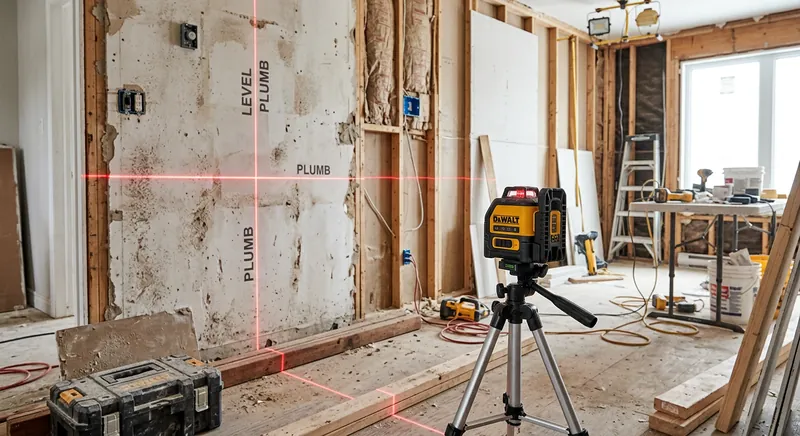
A laser level projects a perfectly level or plumb reference line that replaces the combination of a spirit level, chalk line, and measuring tape. For tile layout, cabinetry installation, shelf hanging, wainscoting, and any project where alignment matters, a laser level saves time and improves accuracy. But laser levels come in several types — cross-line, rotary, and 360-degree — and choosing the right one depends on the kind of work you do and the environment you work in.
Quick Answer
A cross-line laser level is the best choice for most homeowners because it projects both horizontal and vertical lines simultaneously, covering the majority of indoor projects including tile layout, cabinet installation, shelf hanging, and wainscoting. Self-leveling capability is essential, as it automatically adjusts for minor surface deviations within a few degrees and alerts you when the surface is too far out of level. A green laser beam is 4 times more visible than red, especially in bright lighting, though it costs slightly more. For outdoor work or large-scale leveling like fence lines or grading, a rotary laser with a detector is necessary. The main trade-off is between visibility and battery life, with green lasers draining batteries faster. Look for an IP rating of at least IP54 for dust and water resistance on job sites.
Top Picks at a Glance
Self-Leveling Cross-Line Laser
Rotary Laser Level
Compact Line Laser
3D 360° Laser Level
Product Comparison
| Product | Best For | Type | Self-Leveling | Beam Color | Accuracy | Price Range | Details |
|---|---|---|---|---|---|---|---|
Self-Leveling Cross-Line Laser Best Overall | General interior layout, cabinetry, and tile | Cross-line (2-line) | Pendulum, ±3° to ±4° | Red | ±1/8 inch at 30 feet | $80–$150 | View Review ↓ |
Rotary Laser Level Best for Large Sites | Large-scale leveling, grading, and outdoor layout | Rotary | Automatic (electronic) | Red | ±1/16 inch at 100 feet | $200–$400 | View Review ↓ |
Compact Line Laser Best for Small Tasks | Simple leveling and single-line reference | Single-line | Pendulum, ±3° | Red | ±1/4 inch at 30 feet | $30–$60 | View Review ↓ |
3D 360° Laser Level Best for Full-Room Layout | Full-room layout and complex installations | 3D 360° (3-plane) | Pendulum, ±4° | Green | ±1/8 inch at 30 feet | $150–$300 | View Review ↓ |
Self-Leveling Cross-Line Laser
Best Overall- Best For:
- General interior layout, cabinetry, and tile
- Type:
- Cross-line (2-line)
- Self-Leveling:
- Pendulum, ±3° to ±4°
- Beam Color:
- Red
- Accuracy:
- ±1/8 inch at 30 feet
- Price Range:
- $80–$150
Rotary Laser Level
Best for Large Sites- Best For:
- Large-scale leveling, grading, and outdoor layout
- Type:
- Rotary
- Self-Leveling:
- Automatic (electronic)
- Beam Color:
- Red
- Accuracy:
- ±1/16 inch at 100 feet
- Price Range:
- $200–$400
Compact Line Laser
Best for Small Tasks- Best For:
- Simple leveling and single-line reference
- Type:
- Single-line
- Self-Leveling:
- Pendulum, ±3°
- Beam Color:
- Red
- Accuracy:
- ±1/4 inch at 30 feet
- Price Range:
- $30–$60
3D 360° Laser Level
Best for Full-Room Layout- Best For:
- Full-room layout and complex installations
- Type:
- 3D 360° (3-plane)
- Self-Leveling:
- Pendulum, ±4°
- Beam Color:
- Green
- Accuracy:
- ±1/8 inch at 30 feet
- Price Range:
- $150–$300
Detailed Product Reviews & Specifications
Self-Leveling Cross-Line Laser
A self-leveling cross-line laser that projects horizontal and vertical lines simultaneously. Pendulum self-leveling compensates for minor surface unevenness within a specified range, and the lines are bright enough for most indoor applications.
Pros
- •Projects both horizontal and vertical lines
- •Self-leveling saves setup time
- •Good visibility indoors
- •Versatile for most home layout tasks
Cons
- •Lines fade in bright sunlight
- •Limited range compared to rotary lasers
- •Pendulum lock required for transport
Key Specifications
Rotary Laser Level
A rotary laser level that spins a beam to create a full 360-degree horizontal or vertical reference plane. Typically includes a detector for outdoor use where the beam is not visible to the eye. Suitable for larger layout tasks and grading reference.
Pros
- •Full 360-degree reference plane
- •Longer range with detector
- •Suitable for outdoor and large-scale layout
- •Can be used for grading reference
Cons
- •More expensive than line lasers
- •Requires detector for outdoor visibility
- •Heavier and less portable
Key Specifications
Compact Line Laser
A small, affordable laser level that projects a single horizontal or vertical line. Fits in a tool pouch and runs on standard batteries. Practical for quick leveling tasks like hanging pictures, installing a single shelf, or checking alignment.
Pros
- •Small and portable
- •Affordable entry point
- •Simple one-button operation
- •Good for quick leveling checks
Cons
- •Projects only one line at a time
- •Limited accuracy and range
- •Manual leveling on some models
Key Specifications
3D 360° Laser Level
A 360-degree laser level that projects horizontal and vertical planes around the entire room. Green beam provides better visibility than red in most lighting conditions. Ideal for full-room tile, cabinetry, and ceiling work where reference lines are needed on all walls.
Pros
- •360-degree coverage on multiple planes
- •Green beam for superior visibility
- •Excellent for full-room layout
- •Self-leveling with out-of-level alert
Cons
- •Higher price than cross-line models
- •Consumes batteries faster
- •Green beam models cost more than red
Key Specifications
Line Lasers vs Rotary Lasers
Line lasers project a fixed line or lines on a surface. Cross-line models project one horizontal and one vertical line, which is sufficient for most interior room-scale work. 360-degree line lasers project full horizontal and vertical planes around the room, covering all walls at once.
Rotary lasers spin a beam rapidly to create a 360-degree reference plane. They have longer range and are typically paired with a detector for outdoor use. Rotary lasers are more expensive and more complex but excel at large-scale leveling and grading reference work.
Self-Leveling: How It Works and Why It Matters
Self-leveling lasers contain a pendulum that automatically levels the beam within a specified range, typically ±3 to ±4 degrees. Place the laser on a reasonably level surface or tripod, and the pendulum adjusts the beam to true level without manual knob adjustment.
If the surface is too far out of level — beyond the self-leveling range — the laser flashes or beeps to warn you. For angled layout work where you want a line at a specific non-level angle, most pendulum lasers have a lock mode that disables self-leveling and lets you project at any angle.
Green vs Red Laser Beams
Green laser beams are significantly more visible to the human eye than red beams — often three to four times brighter under the same conditions. This makes green beams easier to see in well-lit rooms, near windows, and at greater distances.
The trade-offs are cost and battery life. Green laser diodes are more expensive, which raises the tool price, and they consume more power, which shortens battery runtime. For occasional indoor use in dimmer conditions, a red beam is adequate. For frequent use, bright environments, or longer range, a green beam is worth the investment.
Understanding Accuracy Specifications
Laser level accuracy is specified as a deviation over a distance, such as ±1/8 inch at 30 feet. This means the projected line may deviate from true level by up to 1/8 inch over a 30-foot span. For most home projects, ±1/8 inch at 30 feet is more than adequate.
Higher-accuracy lasers, such as rotary models rated at ±1/16 inch at 100 feet, are designed for larger-scale work where small errors compound over distance. For room-scale interior layout, a cross-line or 360-degree line laser at ±1/8 inch at 30 feet provides sufficient precision.
Frequently Asked Questions
Line lasers are difficult to see outdoors in daylight because the beam is not bright enough against sunlight. Rotary lasers solve this with a detector that senses the beam and signals when it is level. If you need to work outdoors, choose a rotary laser with a detector or a high-visibility green-beam line laser for shorter ranges in shaded conditions.
Final Verdict
For most homeowners, a self-leveling cross-line laser is the best all-around choice. It projects both horizontal and vertical lines, self-levels to save setup time, and has enough accuracy for tile, cabinetry, and shelving. If you do full-room renovations, a 360-degree green-beam laser covers all walls at once with superior visibility. Reserve rotary lasers for large-scale or outdoor work where a 360-degree reference plane and detector are needed. A compact single-line laser is a good value for simple leveling tasks but is limited to one reference at a time.
Sarah Mitchell
Home Improvement Editor
Sarah writes about home improvement products, tools, and materials for HomeGear Guide. Her work focuses on comparing product features, use cases, and practical buying considerations for homeowners.
Related Articles & Buying Guides
 Tools & DIY Equipment
Best Stud Finders for Locating Wall Framing
Compare electronic and magnetic stud finders with depth sensing and AC wire detection. Learn which type reliably locates studs behind drywall.
 Tools & DIY Equipment
Best Circular Saws for Straight Cuts and Ripping
Compare 7-1/4 inch corded and cordless circular saws by blade size, bevel capacity, and motor power. Find the right saw for straight cuts and ripping lumber.
 Tools & DIY Equipment
Best Cordless Drills for Home Projects
Compare 12V and 20V cordless drills with brushless and brushed motors. Find the right balance of power, weight, and battery platform for your home projects.
 Tools & DIY Equipment
Best Impact Drivers for Driving Fasteners
Impact drivers deliver high torque through rapid rotational impacts, making them ideal for driving long screws and lag bolts. Compare options for your home projects.
 Tools & DIY Equipment
Best Pressure Washers for Home Cleaning
Compare electric and gas pressure washers by PSI, flow rate, cleaning units, and pump types to find the right tool for cars, siding, decks, and concrete.
 Tools & DIY Equipment
Best Air Compressors for Home Use
Compare pancake, hot dog, and vertical air compressors by tank size, CFM at 90 PSI, and pump type. Find the right compressor for nail guns and home pneumatic tools.
Get Smarter About Your Home
Receive practical buying guides, product comparisons, maintenance tips and home project ideas from HomeGear Guide.
You can unsubscribe at any time.